The Colorado Classic Minerals Roadmap: Amazonite, Smoky Quartz, and Aquamarine
If you had to describe Colorado’s mineral heritage in three specimens, this is the shortlist:
- Deep blue-green amazonite, ideally with a jet-black smoky quartz crystal growing right through it, on a matrix of pink pegmatite.
- Gemmy smoky quartz alone, the color of dark honey, sometimes reaching a foot long.
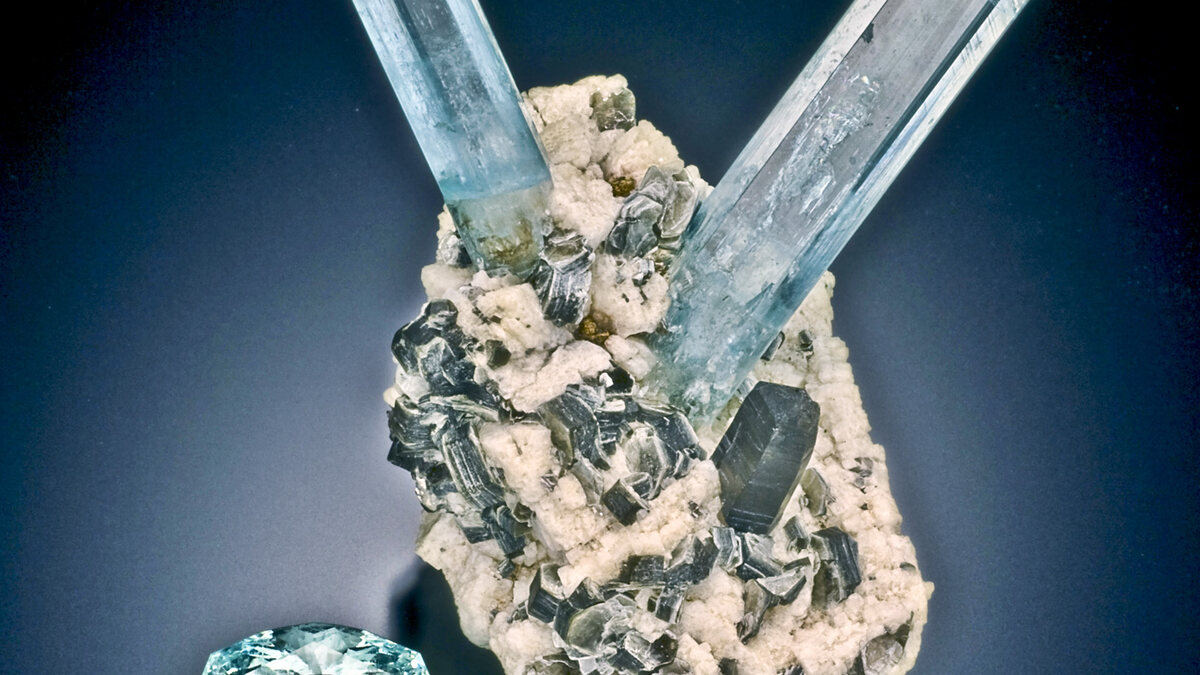
- Sky-blue aquamarine, a hexagonal beryl crystal pulled from talus at 13,500 feet on Mount Antero.
Three minerals. Two mountain areas. One combined geological story that runs from 1.08 billion years ago to your kitchen table tonight. This is the roadmap for understanding where they come from, why they’re world-class, and where to see or find them today.
The Geological Setup
Both localities — the Pikes Peak Batholith and the Mount Antero area — produce these minerals for related reasons rooted in unusual granite chemistry.
The Pikes Peak Batholith (amazonite and smoky quartz country)
About 1.08 billion years ago, a massive volume of magma pushed up into what’s now central Colorado but never quite reached the surface. It cooled slowly, one to two miles deep, forming a huge body of coarse-grained pink granite. Geologists call it “anorogenic” — formed during continental stretching rather than mountain-building. That unusual formation environment left the magma enriched in incompatible elements like fluorine, lithium, and beryllium, which stayed dissolved until the very last stages of crystallization.
Those late-stage residual melts and their gas-rich pockets are called pegmatites. Inside them, big open cavities called miarolitic cavities let crystals grow into empty space — sharp, well-terminated, and often unusually large.
The Pikes Peak Batholith covers about 1,200 square miles across central Colorado and hosts roughly 128 documented mineral species. But the two everyone chases are amazonite and smoky quartz.
Amazonite is a variety of microcline feldspar (potassium feldspar) with trace lead in its structure. The lead is what gives it the distinctive blue-green color. It only forms in a narrow chemical window, which is why most granite in the world produces plain white or pink feldspar and Pikes Peak Batholith pegmatites produce deep blue-green amazonite.
Smoky quartz in the Pikes Peak Batholith is quartz that’s been naturally darkened by radiation over hundreds of millions of years. The uranium and thorium content of the surrounding granite is enough to slowly damage the quartz crystal structure, turning what would be clear rock crystal into deep brown or nearly black smoky. Time and radiation do the work.
When these two minerals grow in the same pocket at the same time — amazonite crystals with smoky quartz crystals growing through them — you get what mineral collectors worldwide consider one of the finest natural combinations ever produced. Nothing else in the world matches Colorado’s Pikes Peak amazonite-smoky quartz combinations.
Mount Antero (aquamarine country)
100 miles southwest of Pikes Peak, in the Sawatch Range, Mount Antero stands at 14,269 feet. It’s the highest of the Colorado fourteeners with commercial gem production. The upper reaches of the mountain expose a smaller intrusive body — the Mount Antero Granite — that intruded about 30 million years ago into older sedimentary and metamorphic rock.
Like the Pikes Peak Batholith, Mount Antero’s granite generated late-stage pegmatites with miarolitic cavities. And like Pikes Peak, the chemistry was unusual enough to produce rare minerals.
Aquamarine is a variety of beryl (beryllium aluminum silicate) colored blue-green by trace iron. It forms as hexagonal prismatic crystals, usually terminated at one or both ends. Mount Antero produces some of the finest aquamarine in North America — pale sky-blue to deeper sea-blue crystals, often intact and gemmy enough to facet.
The Mount Antero area also produces:
- Phenakite — a rare beryllium mineral, sharp lens-shaped crystals, colorless and gem-quality
- Smoky quartz — same story as Pikes Peak, in similar dark-honey colors
- Fluorite — occasionally purple or green
- Bertrandite — another beryllium mineral, secondary to beryl
The catch: everything on Mount Antero happens above 12,000 feet, mostly above 13,500 feet, in scree and talus fields on very steep terrain. The elevation and the exposure make it one of the most physically demanding gem-collecting locations in North America.
Where to See These Minerals
Museums
Colorado has three museums worth planning a trip around if you want to see these classics in person:
- Denver Museum of Nature & Science — The classic destination. NOTE: The Coors Hall of Gems and Minerals closed April 15, 2026 for an 18-month renovation. It reopens in 2027 as the Dea Family Gems and Minerals Hall. Some specimens are rotating through the Denver Gem and Mineral Show while the hall is closed. The Alma King rhodochrosite will return, and the new hall is expected to feature expanded Pikes Peak amazonite and Mount Antero aquamarine displays.
- Colorado School of Mines Geology Museum (Golden) — Free admission. Excellent Colorado material including Pikes Peak amazonite-smoky combinations and Mount Antero aquamarine. Also holds the state’s collection of historic mining artifacts. Highly underrated.
- National Mining Hall of Fame and Museum (Leadville) — Colorado-focused mining history with mineral specimens. Good stop when combined with the Leadville district.
Shows and dealers
- Denver Gem and Mineral Show — Mid-September annually. The single best event in the country for Colorado material. Multiple days, dozens of dealers with authenticated Colorado specimens, museum-quality pieces frequently for sale.
- Lake George Gem and Mineral Club Show — Second weekend in August. Free admission along Highway 24 in Lake George. Smaller than Denver but focused on the Crystal Peak district material with claim holders and field-trip leaders present.
- Collector’s Edge Minerals (Golden) — Direct sales from the operators who worked the Sweet Home Mine rhodochrosite ground. Also carries Pikes Peak and other Colorado material with documented provenance.
- Pikes Peak Rock Shop (Colorado Springs) — Local dealer with consistently strong Pikes Peak inventory.
Where to Actually Collect
Amazonite and Smoky Quartz (Crystal Peak / Pikes Peak Batholith)
The productive ground is heavily claimed. Access requires either:
- Colorado mineral club membership — Lake George Gem and Mineral Club is the top choice for Crystal Peak district access. Denver Gem and Mineral Guild, Colorado Springs Mineralogical Society, and Colorado Mineral Society also run trips.
- Pinnacle 5 Minerals club-only visits — Joseph Dorris’s operation on the Smoky Hawk and adjacent amazonite claims. Club groups only, no walk-ups. Fridays and Saturdays June through July typically.
- Public collecting on non-claimed USFS ground — Some Pike National Forest parcels around Crystal Peak are open. Verify with onX + MyLandMatters before every trip.
Our Crystal Peak Amazonite Field Trip guide covers the access details in depth. The Lake George Amazonite deep-dive covers the geology and the famous pocket discovery stories.
Aquamarine (Mount Antero)
Different challenge entirely. The physical difficulty is the primary limiting factor:
- Elevation: 12,000 to 13,700 feet. Most productive collecting is above 13,000 feet.
- Access: 4WD road from Chalk Creek Road to about 12,700 feet at the trailhead. Everything above requires foot travel over talus. Some jeep tours run scheduled trips.
- Season: Late June through early September realistically. Snow can shut you out any month.
- Weather: Afternoon thunderstorms are nearly daily. Getting caught on the summit ridge during lightning is a genuine risk.
- Claim density: The productive pockets are almost entirely claimed. Casual Use collecting is possible on non-claimed talus but the good ground is spoken for.
If you want to do Mount Antero, the practical options are:
- Guided trip with an outfitter that has claim access. Costs vary. Check with the Salida area outfitters.
- Mineral club trip — Colorado Springs Mineralogical Society and Colorado Mineral Society have historically run Antero trips. Check current schedules.
- Casual Use on non-claimed talus — Legal but the productive ground is a small percentage of the total. Come prepared for altitude and terrain first, aquamarine second.
The Combined Trip
If you have a week and you want to see or find all three classics in one shot, this is the itinerary:
Day 1-2: Denver base
- Colorado School of Mines Geology Museum (free, Golden)
- Collector’s Edge Minerals (Golden, direct sales)
- Museum-quality reference viewing
Day 3-4: Pikes Peak batholith
- Base out of Lake George or Woodland Park
- Attend a Lake George Gem and Mineral Club field trip (join in advance)
- Or arrange a Pinnacle 5 club visit through your Colorado club
- Visit Pikes Peak Rock Shop in Colorado Springs
Day 5-7: Mount Antero area
- Base out of Buena Vista or Salida
- If you’re going up: 4WD access from Chalk Creek Road, camp near the trailhead at 12,700 ft, collect on non-claimed talus above 13,000 ft
- If you’re staying low: visit the Salida area rock shops, catch a Salida-area club talk on Antero collecting
If you’re doing this in September, time it with the Denver Gem and Mineral Show — start there and work outward.
Realistic Expectations for the Classics
Both amazonite/smoky and aquamarine are hard to collect in 2026. Not because the material isn’t there, but because access is limited and the physical demands are real.
- Amazonite/smoky: Club-based access is by far the highest-probability path. Expect to pay dues, attend meetings, and build relationships before you get onto productive ground. Once you’re in, first-trip finds are usually chips and small crystals. Museum-quality combinations happen but are earned across many trips.
- Aquamarine: Physical fitness and altitude tolerance are the gating factors. You need to be able to hike hard at 13,000+ feet and camp near it. Even with claim access, most first-time Antero visitors go home with small crystals and matrix fragments. Big gem-quality aquamarine crystals happen, but they’re the exception.
Buying specimens from reputable dealers is a completely legitimate path. Most serious Colorado collectors combine field collecting with careful buying.
Further Reading
- Our Pikes Peak Pegmatites 101 covers the batholith geology and beginner collecting reality
- Our Lake George Amazonite + Smoky Quartz deep-dive covers the famous pocket discoveries at Two Point Mine
- Our Crystal Peak Amazonite Field Trip guide is the practical access playbook
- Our Hobby Mining Getting Started guide covers the clubs, apps, and gear
- Our Casual Use Prospecting Checklist covers the legal framework
- The full Mining Guide walks through Colorado mineralogy, history, and law
Questions about seeing or collecting Colorado’s classic minerals? Get in touch.